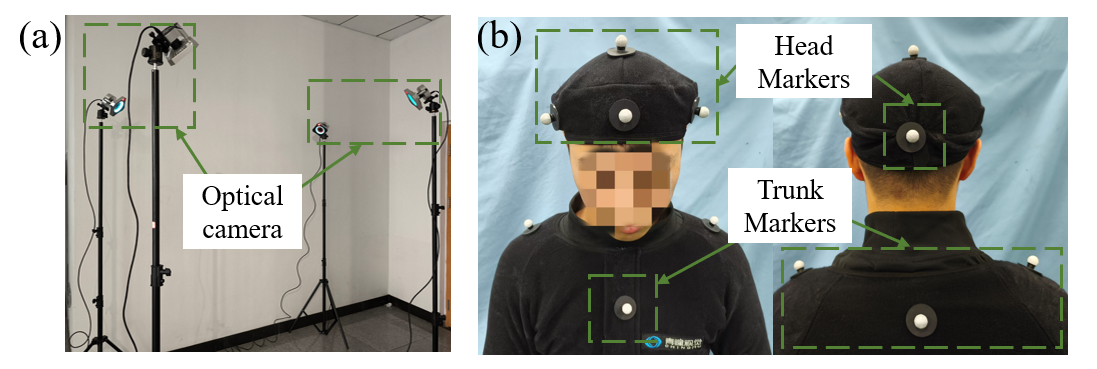
运动信息采集采用的是CHINGMU上海青瞳视觉科技有限公司开发的光学式运动捕捉系统。该系统配备了4台高速光学相机(MC4000),以110Hz的采样频率记录头部运动信息,运动捕捉系统如图2(a)所示。如图2(b)所示,在被试的躯干和头部共放置了9个标记点(Marker),高速摄像机捕捉标记点的时变位置信息,再由采集软件导出位置变化数据,进而通过计算得到头部的运动范围。
本研究招募了5名被试者(年龄:25.6±1.4 岁,身高:180.4±4.3 厘米,体重:70.1±7.9 千克)。每名被试者需分别在穿戴(柔性状态)和不穿戴外骨骼的状态下,以自主舒适的速度完成图3所示的三项运动任务。每项任务重复5次,并计算5次实验的平均活动范围。
5名被试者穿戴外骨骼前后关节运动范围的平均值对比情况如图4所示。图中颜色柱的长度代表5名受试者运动范围的平均值,误差棒代表其标准差。为了分析结果是否具有统计学意义,对运动范围结果进行配对样本T检验,图中*表示 p<0.05,**表示 p<0.01。
实验结果表明,穿戴外骨骼时,5名受试者的头部前屈、左侧旋转和右侧旋转的平均活动范围分别为60.4°±4.7°、28.9°±6.5°和32.6°±4.4°。与不穿戴外骨骼的状态相比,头部前屈、左侧旋转和右侧旋转的活动范围分别减少了7.51±6.2%、58.51±8.4%和56.07±5.0%。研究表明,头部前屈的活动范围能够满足外科医生在手术中的实际需求。尽管左右轴向旋转的活动范围有显著下降,但大多数活动仅需用到颈椎总活动范围的20%至40%,而本研究所提出的颈部外骨骼完全可以满足这一需求。
本研究表明,这种可变刚度颈椎外骨骼能在提供预期头部前屈支撑的同时,不会对正常头部运动造成明显限制。它可减轻颈部肌肉的物理负担,且重量轻、对头部运动限制小,能满足外科手术等场景中长时间头部前屈作业的需求,为解决相关职业人群的颈部健康问题提供了有效途径。
E Tetteh, M S Hallbeck, G A Mirka, “Effects of passive exoskeleton support on EMG measures of the neck, shoulder and trunk muscles while holding simulated surgical postures and performing a simulated surgical procedure,” Appl Ergon, vol. 100, Apr. 2022.
G P Y Szeto, P Ho, A C W Ting, et al, “Work-related musculoskeletal symptoms in surgeons,” J. Occup. Rehabil, vol. 19, pp. 175-184, Apr. 2009.
I Dianat, A Bazazan, M A S Azad, et al, “Work-related physical, psychosocial and individual factors associated with musculoskeletal symptoms among surgeons: Implications for ergonomic interventions,” Appl Ergon, vol. 67, pp. 115-124, Feb. 2018.
T A Plerhoples, T Hernandez-Boussard, S M Wren, “The aching surgeon: a survey of physical discomfort and symptoms following open, laparoscopic, and robotic surgery,” J. Robot. Surg, vol. 6, pp. 65-72, Dec. 2012.
M Wohlauer, D M Coleman, M Sheahan, et al, “SS12. I feel your pain—a day in the life of a vascular surgeon: results of a national survey,” J. Vasc. Surg, vol. 69, Jun. 2019.
P Gorce, J Jacquier-Bret, “Effect of assisted surgery on work-related musculoskeletal disorder prevalence by body area among surgeons: systematic review and meta-analysis,” Int. J. Environ. Res. Public Health, vol .20, Jul. 2023.
E Nutz, J S Jarvers, J Theopold, et al, “Effect of an upper body exoskeleton for surgeons on postoperative neck, back and shoulder complaints,” J Occup Health Psychol, vol. 66, Apr. 2024.
A M Geers, E C Prinsen, D J Van Der Pijl, et al, “Head support in wheelchairs (scoping review): state-of-the-art and beyond,” Disabil. rehabilitation. Assist. Technol, vol. 18, pp. 564-587, May. 2023.
A S A Doss, P K Lingampally, G M T Nguyen, et al, “A comprehensive review of wearable assistive robotic devices used for head and neck rehabilitation,” Results Eng, vol. 19, Sep. 2023.
C A Yee, H Kazerooni, “Reducing occupational neck pain with a passive neck orthosis,” IEEE T-ACES, vol. 13, pp. 403-406, Nov. 2015.
C Zhang, J M Hijmans, C Greve, et al, “A novel passive neck and trunk exoskeleton for surgeons: design and validation,” J. Bionic Eng, pp. 1-12, Dec. 2024.
H Zhang, K Albee, S K Agrawal, “A spring-loaded compliant neck brace with adjustable supports,” Mech Mach Theory, vol. 125, pp. 34-44, Jul 2018.
S P Torrendell, H Kadone, M Hassan, et al, “A neck orthosis with multi-directional variable stiffness for persons with dropped head syndrome,” IEEE Rob. Autom. Lett, vol. 9, pp. 6224-6231, Jul 2024.
B C Chang, H Zhang, S Long, et al, “A novel neck brace to characterize neck mobility impairments following neck dissection in head and neck cancer patients,” Wearable Technologies, vol. 2, Jul. 2021
L Yang, T Wang, T K Weidner, et al, “Intraoperative musculoskeletal discomfort and risk for surgeons during open and laparoscopic surgery,” Surg Endosc, vol. 35, pp. 6335-6343, Nov. 2021.
D G Cobian, N S Daehn, P A Anderson, et al, “Active cervical and lumbar range of motion during performance of activities of daily living in healthy young adults,” Spine, vol. 38, pp. 1754-1763, Sep. 2013.
H Yajima, R Nobe, M Takayama, et al, “The mode of activity of cervical extensors and flexors in healthy adults: A cross-sectional study,” Medicina, vol. 58, May. 2022.
M N Mahmood, A Tabasi, I Kingma, et al, “A novel passive neck orthosis for patients with degenerative muscle diseases: development & evaluation,” J Electromyogr Kinesiol, vol. 57, Apr. 2021.
E A Keshner, D Campbell, R T Katz, et al, “Neck muscle activation patterns in humans during isometric head stabilization,” Exp Brain Rese, vol. 75, pp. 335-344, Apr. 1989.
H Zhang, S K Agrawal, “Kinematic design of a dynamic brace for measurement of head/neck motion,” IEEE Rob. Autom. Let, vol. 2, pp. 1428-1435, Jul 2017.